
Best remote jobs in the USA for beginners can provide a flexible way to start a new career, gain professional experience, or find work-from-home opportunities without commuting to an office.
In 2026, remote work covers a wide range of roles, including customer support, virtual assistance, writing, social media, tutoring, graphic design, sales, and other digital positions. Some roles require previous experience, while others can be accessible to beginners who have basic computer, communication, or organizational skills.
However, finding a legitimate remote job requires more than simply searching for “work from home” positions.
You need to understand:
- which remote jobs are suitable for beginners,
- what skills each role requires,
- where to find legitimate opportunities,
- how to identify remote job scams,
- whether a position is available to applicants in your location,
- and how AI tools can improve your productivity.
This guide explains 10 beginner-friendly remote job options, along with practical tips for getting started.
Important: A remote position advertised by a U.S. company may still have location, work-authorization, tax, or time-zone requirements. Always check the employer’s eligibility requirements before applying.
If you’re also interested in building an online income stream, you can read our guide on how to build an online business with AI in 2026.
What Are Remote Jobs?
A remote job is a position that allows an employee or contractor to perform some or all of their work away from a traditional office.
Depending on the employer, remote work may be:
- fully remote,
- partially remote or hybrid,
- location-specific,
- or open to workers in multiple countries.
This distinction is important.
For example, a job may say “remote” but require the employee to live in a particular U.S. state. Another position may be open to workers anywhere in the United States, while a freelance project may accept international contractors.
Therefore, beginners should always read the complete job description before applying.
Why Are Remote Jobs Popular?
Remote work can offer several practical benefits for both employers and workers.
For workers, potential advantages include:
- reduced commuting,
- flexible working arrangements,
- access to jobs outside their immediate area,
- and the ability to work from a home office.
For employers, remote work can make it easier to build distributed teams and hire people across different locations.
Technology has also made remote collaboration easier. Tools such as Zoom, Slack, Microsoft Teams, Google Workspace, project-management platforms, and AI assistants allow distributed teams to communicate and manage work online.
However, remote work is not automatically easier than office work. Employees still need to meet deadlines, communicate effectively, attend meetings when required, and maintain consistent performance.
Best Remote Jobs in the USA for Beginners
The following roles can be worth exploring if you’re new to remote work. The actual requirements, pay, schedule, and availability vary by employer.
1. Customer Support Representative
Customer support is one of the more recognizable entry-level remote career paths.
Remote customer support representatives may communicate with customers through:
- email,
- live chat,
- phone,
- help-desk systems,
- or social media.
Typical responsibilities can include answering questions, troubleshooting basic problems, processing requests, and documenting customer interactions.
Skills You May Need
Commonly useful skills include:
- clear written communication,
- active listening,
- patience,
- basic computer skills,
- problem-solving,
- and attention to detail.
Some employers provide training for new employees, while others prefer applicants with previous customer-service experience.
Who Is It Suitable For?
Customer support may be suitable for beginners who are comfortable communicating with people and following established procedures.
It can also provide experience that later helps you move into customer success, sales, account management, or other business roles.
2. Virtual Assistant
A virtual assistant, commonly called a VA, provides administrative or digital support remotely.
Depending on the client or company, tasks can include:
- managing emails,
- scheduling appointments,
- updating spreadsheets,
- conducting online research,
- organizing files,
- preparing documents,
- managing calendars,
- or assisting with social media.
Why Virtual Assistance Can Be Beginner-Friendly
Virtual assistance does not always require advanced technical knowledge.
Organization, reliability, communication, and attention to detail can be just as important.
As you gain experience, you can specialize in areas such as:
- social media management,
- e-commerce assistance,
- executive assistance,
- research,
- or content operations.
Freelance marketplaces such as Upwork and Fiverr can be starting points for exploring freelance VA work.
3. Freelance Writer
If you enjoy writing, freelance writing can be another remote work option.
Businesses and publishers may hire writers for:
- blog articles,
- website pages,
- product descriptions,
- newsletters,
- social media content,
- technical documentation,
- and other forms of digital content.
You can learn more about improving your content workflow in our guide to the best AI tools for blog writing in 2026.
Skills That Help
A beginner writer should focus on:
- grammar,
- research,
- clear writing,
- fact-checking,
- understanding the target audience,
- and meeting deadlines.
AI tools can assist with brainstorming, outlining, editing, and productivity, but writers should still review AI-generated information carefully.
Where to Find Writing Projects
Potential platforms include:
Building a small portfolio can make it easier to demonstrate your ability to potential clients.
4. Social Media Assistant or Manager
Businesses of all sizes use social media to communicate with customers and promote their products or services.
Depending on the position, a social media professional may:
- schedule posts,
- create captions,
- prepare graphics,
- monitor comments,
- respond to messages,
- research content ideas,
- and track performance metrics.
A beginner may initially work as a social media assistant before taking on broader management responsibilities.
Useful Beginner Skills
You can start by learning:
- Canva,
- basic copywriting,
- social media scheduling,
- simple analytics,
- content planning,
- and platform-specific best practices.
For example, Canva can help beginners create social media graphics without requiring advanced graphic-design software.
You can also explore our guide to the best AI tools for small businesses in the USA to learn how businesses use digital tools to improve productivity.
5. Data Entry Specialist
Data entry involves entering, updating, checking, or organizing information in digital systems.
Examples can include:
- entering information into spreadsheets,
- updating databases,
- transferring information between systems,
- checking records,
- and organizing digital documents.
Skills Required
Data entry generally requires:
- typing accuracy,
- attention to detail,
- basic spreadsheet knowledge,
- computer literacy,
- and consistency.
Because data-entry jobs are often advertised to beginners, this category also attracts scammers.
Be especially careful with advertisements promising unusually high earnings for very simple work.
Never assume that a job is legitimate simply because it appears on a website or social-media platform.
6. Online Tutor
Online tutoring allows people to teach students through video calls and specialized education platforms.
Possible subjects include:
- mathematics,
- science,
- English,
- languages,
- music,
- coding,
- and test preparation.
Some tutoring positions require formal teaching qualifications or subject-specific credentials. Others may have different requirements depending on the platform and subject.
Examples of online tutoring platforms include:
Before applying, check the platform’s current requirements, supported countries, payment terms, and age or qualification restrictions.
7. Graphic Designer
Graphic design can be a useful remote career path for people who enjoy visual creativity.
Remote graphic designers may create:
- social media graphics,
- presentation slides,
- advertisements,
- website graphics,
- thumbnails,
- logos,
- and marketing materials.
Can Beginners Learn Graphic Design?
Yes, but becoming employable requires practice.
Beginners can start with accessible tools such as Canva and gradually learn more advanced design software.
A small portfolio is particularly important for design work because clients often want to see examples before hiring someone.
Instead of simply saying that you’re a designer, create several sample projects demonstrating different skills.
8. Sales Development Representative
Sales is another remote career area that beginners can investigate.
A Sales Development Representative, or SDR, may help businesses find potential customers and start conversations with prospects.
Typical responsibilities can include:
- researching prospects,
- sending emails,
- making calls,
- qualifying leads,
- scheduling meetings,
- and updating customer relationship management systems.
Skills That Matter
Useful skills include:
- communication,
- listening,
- research,
- persistence,
- organization,
- and understanding customer needs.
Some employers provide structured training, while others prefer previous sales or customer-service experience.
Sales experience can also provide a pathway into account management, business development, or customer success roles.
9. Content or SEO Assistant
If you are interested in blogging, marketing, or search engines, an SEO or content assistant role may be worth exploring.
Tasks can include:
- keyword research,
- content organization,
- updating old articles,
- creating content briefs,
- checking on-page SEO,
- internal linking,
- competitor research,
- and basic website updates.
You do not necessarily need to be an SEO expert to begin learning these skills.
Start with fundamental concepts such as:
- search intent,
- keyword research,
- title optimization,
- headings,
- internal links,
- helpful content,
- and basic analytics.
You can also improve your SEO knowledge through our guide to the best SEO tools for bloggers in 2026.
10. IT or Technical Support Assistant
Technical support can be a good option for beginners who enjoy troubleshooting computers, software, or online services.
Depending on the position, responsibilities may include:
- helping users solve basic technical problems,
- resetting passwords,
- documenting support requests,
- troubleshooting software issues,
- and escalating complex problems to specialized teams.
Some entry-level technical support positions provide training, while others may require certifications or previous experience.
If you enjoy technology and want a longer-term career path, learning basic networking, operating systems, cybersecurity concepts, and troubleshooting can be useful.
Remote Jobs vs. Online Business: What’s the Difference?
This distinction is important when choosing your career path.
A remote job usually involves working for an employer or organization under defined responsibilities and employment or contractor terms.
An online business involves creating your own income-generating activity.
For example:
| Remote Job | Online Business |
|---|---|
| Customer support | Blogging |
| Virtual assistant | Affiliate marketing |
| Sales representative | Digital products |
| Technical support | YouTube |
| Content assistant | Online courses |
| Graphic designer | Freelance agency |
Blogging and affiliate marketing can certainly generate online income, but they should not be presented as traditional “remote jobs.”
If your goal is to build an independent online income stream, our guides on best affiliate programs for beginners in the USA and best blogging platforms for beginners in the USA may be useful starting points.
Comparison Table: Beginner Remote Jobs
| Remote Role | Beginner Accessibility | Common Skills | Work Flexibility |
|---|---|---|---|
| Customer Support | Often accessible | Communication, problem-solving | Varies |
| Virtual Assistant | Often accessible | Organization, communication | Often flexible |
| Freelance Writer | Portfolio helpful | Writing, research | Often flexible |
| Social Media Assistant | Portfolio helpful | Content, social media | Often flexible |
| Data Entry | Often accessible | Accuracy, spreadsheets | Varies |
| Online Tutor | Depends on subject | Teaching, communication | Often flexible |
| Graphic Designer | Portfolio important | Design, creativity | Often flexible |
| Sales Development Representative | Varies | Communication, sales | Varies |
| SEO/Content Assistant | Beginner-friendly with training | SEO, writing, research | Varies |
| Technical Support | Varies | Troubleshooting, computer skills | Varies |
Note: “Beginner accessibility” does not mean that every employer will accept applicants without experience. Requirements, location restrictions, schedules, compensation, and qualifications vary by position.
Where to Find Legitimate Remote Jobs
One of the most important steps for beginners is choosing reliable places to search.
You can explore platforms such as:
Upwork
Upwork is a freelance marketplace where businesses post projects for independent professionals.
It can be useful for writing, virtual assistance, design, development, marketing, and other freelance services.
Fiverr
Fiverr allows freelancers to create service listings that potential customers can purchase.
It can be useful when you want to package a specific skill into a defined service.
FlexJobs
FlexJobs focuses on remote, flexible, and other non-traditional work opportunities.
Check its current pricing and job-search features before deciding whether it fits your needs.
Remote.co
Remote.co focuses on remote-work opportunities and remote-work resources.
We Work Remotely
We Work Remotely is another platform where users can explore remote job listings across different categories.
Company Career Pages
Don’t rely only on job marketplaces.
If you already know which companies interest you, visit their official career pages and check whether they offer remote positions.
This can also help you verify that a job advertisement actually comes from the company claiming to be hiring.
How to Avoid Remote Job Scams
Remote job scams are an important issue for beginners because scammers often use attractive work-from-home offers to collect money or personal information.
Watch for the following warning signs.
1. Requests for Large Upfront Payments
Be cautious if someone asks you to pay a large fee to receive a job.
The Federal Trade Commission provides consumer guidance about recognizing and avoiding job scams. You can review its information at the FTC Consumer Advice website.
2. Unrealistic Earnings Promises
Be skeptical of advertisements promising extremely high income for very little work.
Statements such as “earn thousands every week with no experience” should encourage you to investigate further rather than immediately applying.
3. Requests for Sensitive Information Too Early
Avoid sending sensitive personal or financial information before you have verified the employer and understand why the information is required.
4. Unverified Recruiters
Check the recruiter’s email address, company website, job listing, and professional presence.
If the recruiter claims to represent a company, independently visit the company’s official website instead of relying only on links or documents they provide.
5. Pressure to Act Immediately
Scammers may try to create urgency by claiming that you must pay or provide information immediately.
Take time to verify the opportunity.
Skills That Can Help You Get Remote Work
You don’t need to learn dozens of skills at once.
Choose one area and build practical ability around it.
Useful remote-work skills include:
- written communication,
- customer service,
- spreadsheet skills,
- project management,
- SEO,
- content writing,
- graphic design,
- video editing,
- social media management,
- basic sales,
- and AI productivity tools.
For example, someone interested in writing could start with content writing, then learn SEO and eventually specialize in SEO content.
A graphic-design beginner could start with social media graphics and later move into branding or marketing design.
The goal is to build a combination of skills rather than collecting random certificates.
How AI Can Help Remote Workers
AI is becoming part of many digital workflows.
Depending on the job, AI tools can help with:
- brainstorming,
- summarizing information,
- drafting content,
- improving grammar,
- organizing tasks,
- analyzing information,
- creating design concepts,
- and automating repetitive workflows.
However, AI should be treated as a productivity tool rather than a replacement for professional judgment.
For example, a customer-support worker still needs to understand the customer’s problem. A writer still needs to fact-check information. A designer still needs to understand the client’s requirements.
You can learn more about practical AI workflows in our guide on how to use AI to make money online in 2026.
How to Get Your First Remote Job With Little or No Experience
Getting your first remote position can be difficult because employers often want evidence that you can perform the work.
You can improve your chances by following a simple process.
Step 1: Choose One Job Category
Don’t apply randomly to every remote job.
Choose one or two categories that match your interests and current skills.
For example:
Good starting combination:
Writing + SEO
or
Another option:
Virtual assistance + social media
Step 2: Learn the Basic Skills
Use free tutorials, documentation, practice projects, and beginner courses.
Focus on practical skills rather than collecting certificates without applying what you learn.
Step 3: Create a Small Portfolio
A portfolio can demonstrate your ability even when you don’t have professional experience.
For example, an aspiring writer can create three sample articles.
A designer can create five sample social media graphics.
A virtual assistant can create a sample spreadsheet, calendar system, and research document.
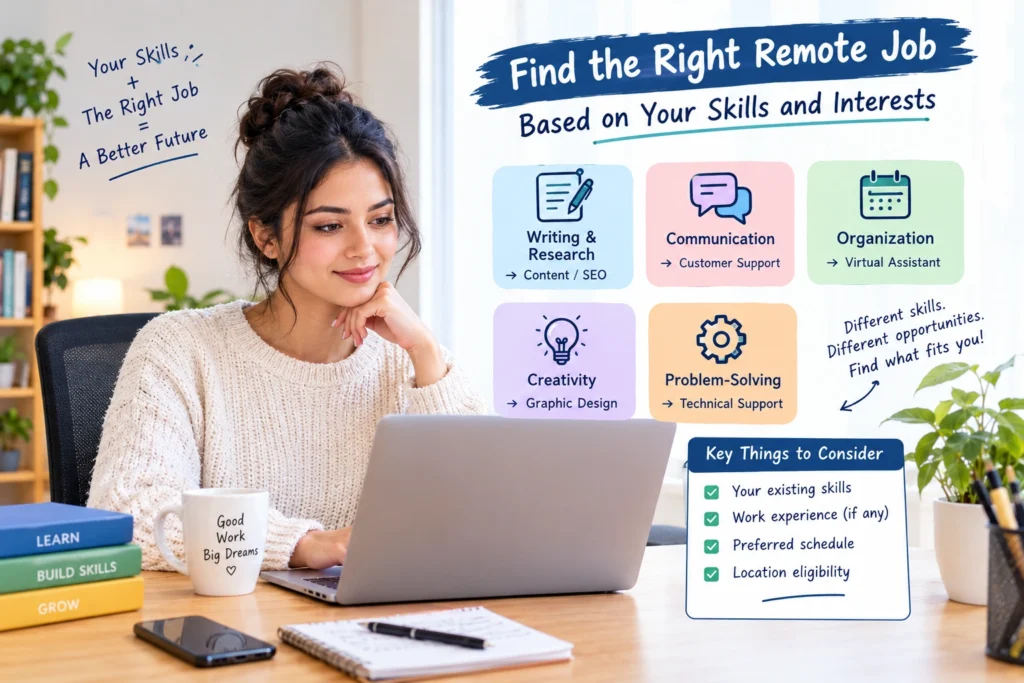
Not sure which remote career path matches your strengths? Use the visual guide below to explore a few options.
Step 4: Create a Professional Profile
Your profile should clearly explain:
- what you do,
- what tools you use,
- what problems you can solve,
- and what type of work you are looking for.
Avoid making your profile overly broad.
Step 5: Apply Consistently
Remote positions can receive many applications.
Apply to roles that genuinely match your skills instead of sending the same generic application everywhere.
Step 6: Keep Improving
Use feedback from applications and interviews to improve your portfolio, resume, communication, and technical skills.
Can You Get a Remote Job Without a Degree?
Yes, some remote positions do not require a college degree.
However, this does not mean qualifications are unnecessary.
Depending on the role, employers may care more about:
- relevant skills,
- experience,
- communication,
- portfolio quality,
- certifications,
- or demonstrated ability.
For example, a graphic-design position may place significant emphasis on a portfolio, while a customer-support position may focus more heavily on communication and problem-solving.
Always check the specific requirements of each position.
Can You Work for a U.S. Company From Another Country?
Sometimes, but it depends on the employer and position.
A job described as “remote” may still be restricted to employees living in the United States or specific states.
International applicants may encounter additional considerations involving:
- work authorization,
- tax obligations,
- contractor arrangements,
- payment methods,
- time zones,
- and local employment laws.
If you are outside the United States, do not assume that a U.S.-based remote job is automatically available to you.
Look for listings that explicitly state whether international applicants are accepted.
Frequently Asked Questions
What is the easiest remote job for a beginner?
There is no single easiest remote job for everyone. Customer support, virtual assistance, data entry, and some freelance services can be accessible starting points depending on your skills and the employer’s requirements.
Can I get a remote job with no experience?
Yes, some entry-level remote positions accept applicants with limited professional experience. Creating a portfolio, developing practical skills, and clearly presenting your abilities can help.
Can I work remotely without a degree?
Some remote roles do not require a degree. Requirements vary significantly by employer and job category.
Are remote jobs legitimate?
Yes, many legitimate companies offer remote positions. However, remote job scams also exist, so verify the employer and avoid suspicious payment requests or unrealistic offers.
Can I work for a U.S. company from outside the USA?
Some companies hire international remote workers, while others restrict positions to people located in the United States or particular regions. Always check the job’s location and eligibility requirements.
Can AI help me get a remote job?
AI can help with tasks such as researching companies, improving a resume, practicing interviews, organizing applications, and learning skills. You should still provide accurate information about your experience and review AI-generated material before using it.
What skills should beginners learn for remote work?
Communication, writing, customer service, spreadsheets, SEO, design, social media, sales, technical support, and AI productivity skills can all be useful depending on the career path you choose.
Final Thoughts
The best remote jobs in the USA for beginners depend on your existing skills, interests, location, and career goals.
You don’t need to learn everything before applying.
Instead, choose one practical skill, build a small portfolio, search legitimate job listings, and improve your abilities through real projects.
Customer support and virtual assistance can be useful starting points for people with strong organizational and communication skills. Writing, design, social media, SEO, and technical support can provide different paths for people who want to develop specialized digital skills.
If your goal is independent online income rather than traditional employment, blogging, affiliate marketing, freelancing, and digital products are separate paths worth exploring.
Most importantly, don’t focus only on finding a “quick” remote job.
Focus on developing a skill that businesses and customers genuinely need.
That approach can give you a stronger foundation for building sustainable remote work opportunities over time.
About the Author
Hi, we are the founders of EveryTechHub. We share beginner-friendly guides about AI tools, blogging, and technology, with a focus on practical workflows and easy-to-understand tutorials. Read more about us.