
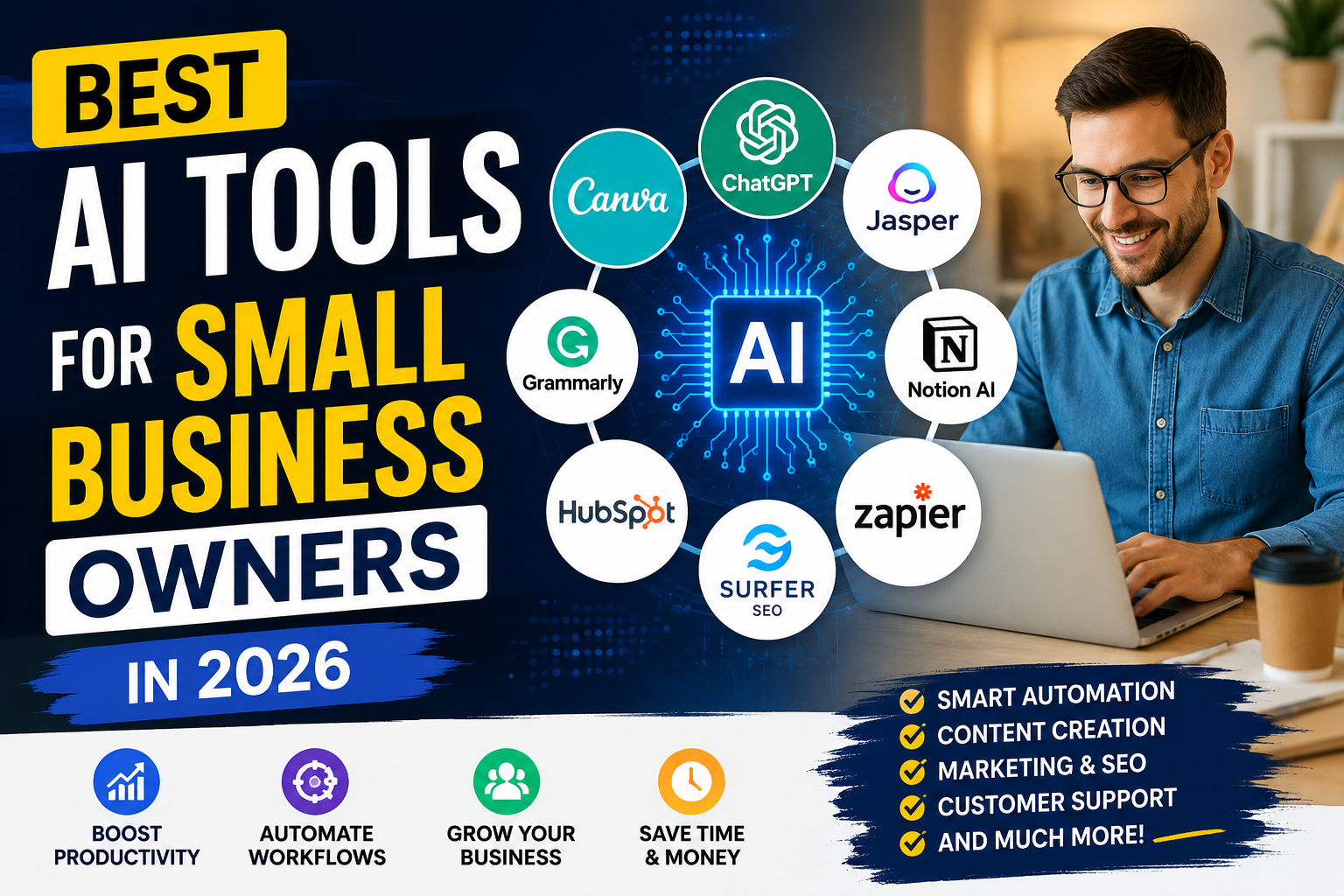
Running a small business in 2026 is very different from what it was just a few years ago.
Today, business owners are expected to manage:
- marketing,
- customer support,
- content creation,
- email campaigns,
- social media,
- SEO,
- and productivity workflows—
often with limited time and small teams.
That’s where AI tools are becoming incredibly valuable.
The best AI tools for small business owners can help automate repetitive tasks, improve productivity, save time, and support smarter business decisions without requiring advanced technical skills.
The good news?
Many modern AI tools are beginner-friendly, affordable, and designed specifically for entrepreneurs, freelancers, creators, and growing businesses.
In this guide, we’ll explore:
- the best AI tools for small business owners in 2026,
- what each tool does,
- pricing and beginner-friendliness,
- productivity benefits,
- and how AI can support long-term business growth.
This article focuses on practical and Google-safe recommendations designed for real business use cases.
👉 If you are building an online brand, you may also enjoy our guide on how to build an online business with AI in 2026.
Why Small Businesses Are Using AI Tools
AI is no longer limited to large corporations.
Today, small businesses use AI for:
- content creation,
- customer communication,
- marketing automation,
- analytics,
- and workflow management.
According to Forbes, AI adoption among small businesses continues growing as tools become more affordable and accessible.
For small business owners, AI can help:
- reduce repetitive work,
- improve efficiency,
- and free up time for more important tasks.
However, AI works best when combined with human creativity, communication, and decision-making.
What Makes a Good AI Tool for Small Businesses?
Not every AI platform is ideal for beginners.
The best AI tools for small business owners usually offer:
- beginner-friendly dashboards,
- practical automation,
- affordable pricing,
- integrations,
- and real productivity benefits.
Small businesses should focus on tools that solve actual problems instead of chasing unnecessary AI trends.
1. ChatGPT
ChatGPT remains one of the most widely used AI tools for businesses in 2026.
It can help with:
- content ideas,
- email drafts,
- customer communication,
- brainstorming,
- and productivity tasks.
Why Small Businesses Use ChatGPT
Business owners often use ChatGPT to:
- save writing time,
- organize ideas,
- create outlines,
- and improve workflow efficiency.
👉 Official Website: ChatGPT by OpenAI
👉 You may also enjoy our guide on 100+ powerful ChatGPT prompts for blogging, SEO & writing.
2. Canva
Canva has become one of the most popular design platforms for small businesses.
It helps users create:
- social media graphics,
- presentations,
- marketing materials,
- and website visuals.
Why Beginners Like Canva
Canva offers:
- drag-and-drop editing,
- AI-powered design tools,
- templates,
- and beginner-friendly workflows.
Many small business owners use Canva even without professional design experience.
👉 Official Website: Canva
3. Grammarly
Professional communication matters for every business.
Grammarly helps improve:
- grammar,
- readability,
- tone,
- and clarity.
Best Use Cases
Businesses use Grammarly for:
- emails,
- blog posts,
- marketing copy,
- and customer communication.
👉 Official Website: Grammarly
4. Jasper AI
Jasper AI focuses heavily on AI-assisted marketing and content creation.
It can help create:
- blog content,
- ad copy,
- product descriptions,
- and email campaigns.
Why Businesses Use Jasper
Small businesses often use Jasper to improve content production efficiency while maintaining consistent messaging.
👉 Official Website: Jasper AI
5. Notion AI
Notion AI combines productivity, organization, and AI assistance in one workspace.
It is useful for:
- task management,
- notes,
- planning,
- and collaboration.
Why It’s Popular
Small teams appreciate Notion AI because it helps organize projects and workflows more efficiently.
👉 Official Website: Notion
6. HubSpot AI
HubSpot is a popular CRM and marketing platform that now includes AI-powered tools.
Businesses use it for:
- email marketing,
- customer management,
- lead tracking,
- and automation.
Why Small Businesses Use HubSpot
HubSpot combines:
- marketing,
- customer support,
- and sales tools in one ecosystem.
👉 Official Website: HubSpot
👉 You may also enjoy our guide on best email marketing tools for beginners in 2026.
7. Surfer SEO
SEO continues to be one of the best long-term traffic strategies for online businesses.
Surfer SEO helps optimize content for search engines using AI-assisted recommendations.
Features
It helps with:
- keyword optimization,
- content structure,
- and SEO analysis.
👉 Official Website: Surfer SEO
8. Zapier AI
Automation saves significant time for small businesses.
Zapier helps connect apps and automate repetitive workflows.
Example Automations
Businesses use Zapier to:
- automate emails,
- sync customer data,
- and reduce manual tasks.
👉 Official Website: Zapier
9. Pictory
Video marketing continues growing rapidly.
Pictory helps create videos using AI-powered editing tools.
Why It’s Useful
Small businesses use Pictory for:
- social media clips,
- promotional videos,
- and content repurposing.
👉 Official Website: Pictory
10. Trello with AI Integrations
Project management is important for productivity and organization.
Trello helps teams manage:
- tasks,
- deadlines,
- and workflows.
AI integrations can improve workflow suggestions and automation.
👉 Official Website: Trello
Comparison Table: Best AI Tools for Small Business Owners
| Tool | Beginner Friendly | Best For | Free Plan | AI Features |
| ChatGPT | Yes | Writing & productivity | Yes | Strong |
| Canva | Yes | Graphic design | Yes | Medium |
| Grammarly | Yes | Writing improvement | Yes | Medium |
| Jasper AI | Medium | Marketing content | Limited | Strong |
| Notion AI | Yes | Organization | Yes | Medium |
| HubSpot AI | Medium | CRM & marketing | Yes | Strong |
| Surfer SEO | Medium | SEO optimization | No | Strong |
| Zapier | Medium | Automation | Yes | Medium |
| Pictory | Yes | Video creation | Limited | Medium |
| Trello | Yes | Project management | Yes | Medium |
How AI Helps Small Businesses Save Time
One of the biggest advantages of AI is automation.
AI tools can reduce time spent on:
- repetitive writing,
- scheduling,
- data organization,
- and marketing tasks.
This allows business owners to focus more on:
- growth,
- customer relationships,
- and strategy.
AI and Content Marketing
Content marketing remains important for:
- SEO,
- audience growth,
- and online visibility.
AI tools can help businesses:
- generate ideas,
- improve consistency,
- and speed up content workflows.
👉 You may also enjoy our article on best AI tools for affiliate marketing in 2026.
However, AI-generated content should still be reviewed and personalized by humans.
How AI Supports SEO
SEO tools powered by AI can help:
- optimize content,
- identify keywords,
- and improve readability.
👉 If you want more SEO guidance, check out our guide on best SEO tools for bloggers in 2026.
SEO remains one of the best long-term traffic strategies for online businesses.
Can AI Replace Employees?
AI can automate certain repetitive tasks, but human creativity and communication remain extremely valuable.
Successful businesses usually use AI to:
- support productivity,
- reduce manual work,
- and improve efficiency—
not completely replace people.
Tips for Choosing the Right AI Tool
Start Small
Do not subscribe to too many tools at once.
Focus on Real Problems
Choose tools that solve actual workflow challenges.
Test Free Plans First
Many AI tools offer free versions or trials.
Prioritize Ease of Use
Complicated tools may slow down beginners unnecessarily.
Common Mistakes Small Businesses Make with AI
Relying Entirely on Automation
AI still requires human oversight and editing.
Using Too Many Tools
Too many platforms can create workflow confusion.
Ignoring Brand Voice
Businesses should maintain authentic communication styles.
How AI Is Changing Small Businesses in 2026
AI is helping businesses:
- operate more efficiently,
- improve customer support,
- create content faster,
- and automate workflows.
At the same time, competition is increasing because more businesses now have access to similar tools.
That’s why:
- strategy,
- consistency,
- and human creativity still matter greatly.
FAQ
What are the best AI tools for small business owners?
Popular options include ChatGPT, Canva, Grammarly, Jasper AI, Notion AI, and HubSpot.
Can beginners use AI tools easily?
Yes. Many modern AI platforms are designed for beginners and small businesses.
Are AI tools expensive?
Some tools offer free plans, while premium versions vary depending on features.
Can AI improve marketing?
Yes. AI can assist with content creation, email marketing, SEO, and automation.
Is AI safe for business use?
Yes, when used responsibly and combined with human review and decision-making.
Final Thoughts
The best AI tools for small business owners in 2026 are helping entrepreneurs work smarter, improve productivity, and automate repetitive tasks.
Whether you run:
- a blog,
- freelance business,
- online store,
- or local company,
AI tools can support growth when used strategically.
The key is to:
- choose practical tools,
- focus on real business needs,
- and combine AI efficiency with human creativity.
Technology continues evolving, but businesses that provide genuine value and strong customer experiences will remain successful long term.
Final Tip
👉 Start with one or two AI tools that solve your biggest business challenges instead of trying every trending platform at once. Consistent workflows and practical implementation usually produce better results than constantly switching between tools.
About the Author
Hi, We are the founders of EveryTechHub. We share beginner-friendly guides on AI tools, blogging, and technology based on hands-on testing and real experience. Read more about us.