
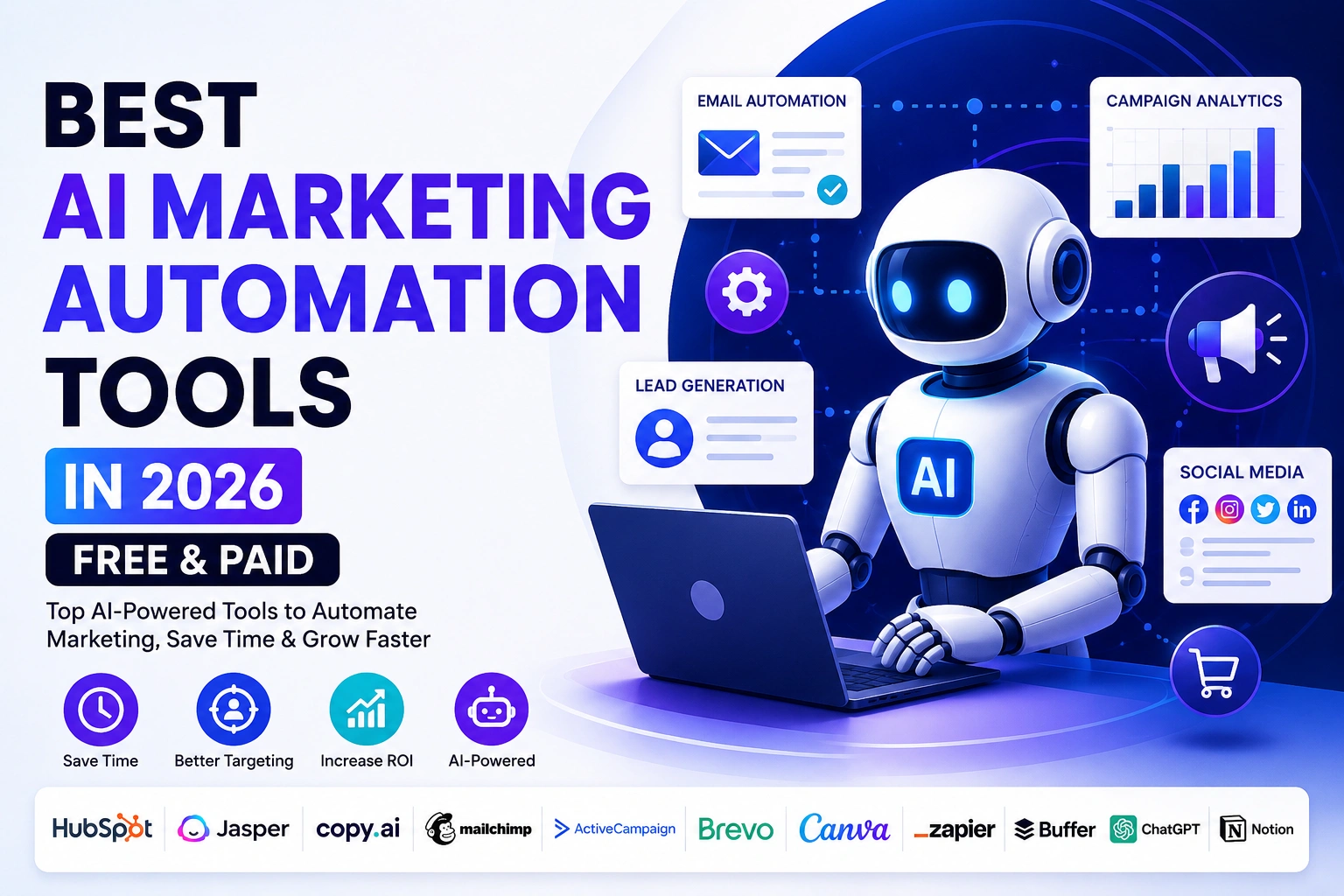
Quick Answer: The best AI marketing automation tools in 2026 include HubSpot AI, Jasper AI, Mailchimp, ActiveCampaign, Brevo, Canva, Zapier, Buffer, Surfer SEO, ChatGPT, Copy.ai, and Notion AI. Free options like ChatGPT, Canva, Buffer, Mailchimp, and Brevo work well for beginners and small teams, while paid platforms like HubSpot, ActiveCampaign, and Jasper offer deeper automation, personalization, and reporting for growing businesses.
Introduction
Best AI Marketing Automation Tools in 2026 are changing how bloggers, small businesses, and marketing agencies get work done. Instead of manually writing emails, scheduling social posts, and analyzing customer data, marketers can now let AI handle repetitive tasks while they focus on strategy. This shift matters more in 2026 than ever, because customers expect fast, personalized experiences and businesses simply can’t keep up using manual methods alone.
AI marketing automation software helps save time, improve customer engagement, generate more qualified leads, and increase conversions without requiring a full marketing department. Whether you’re a solo blogger experimenting with free AI marketing automation tools or an established brand investing in paid AI marketing platforms, there’s an option that fits your budget and goals.
In this guide, we’ll break down the best AI marketing tools for 2026, covering both free and paid options, so you can build a smarter, leaner marketing stack. This list is useful for anyone researching Best AI Tools for Content Creators or exploring the broader AI Tools category on Everytechhub.
What Is AI Marketing Automation?
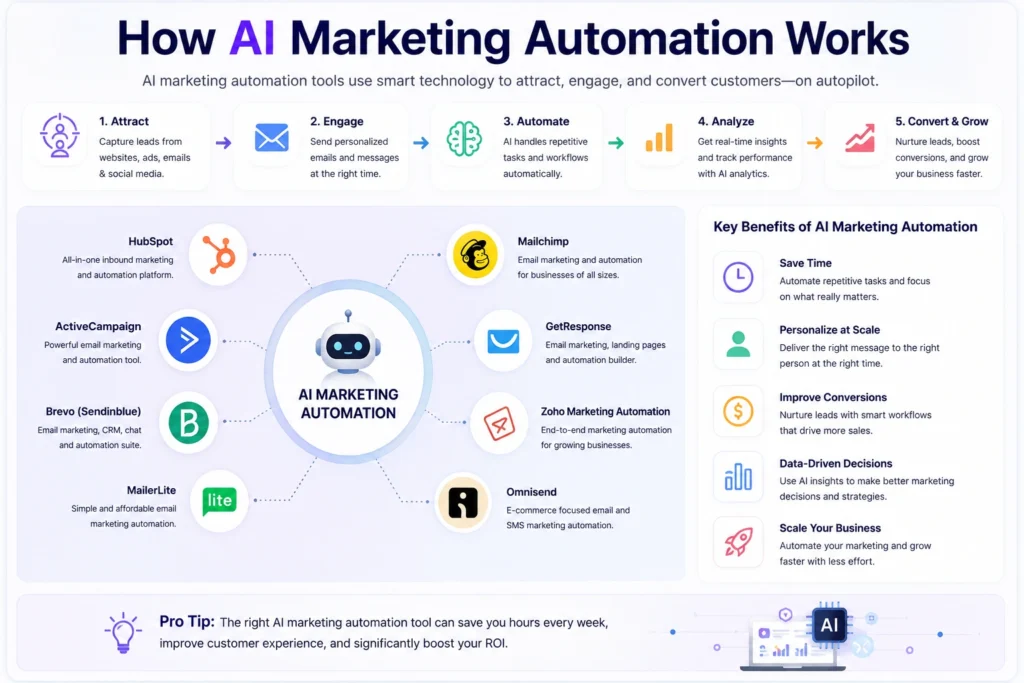
AI marketing automation combines traditional marketing automation (scheduled emails, workflows, triggers) with artificial intelligence that can learn, predict, and generate content on its own. In simple terms, it’s software that doesn’t just follow rules you set — it makes smarter decisions using data.
Traditional automation might send an email when someone joins your list. AI-powered automation goes further: it can decide the best time to send that email, write the subject line, personalize the content for each subscriber, and predict who’s likely to convert.
Common tasks AI can automate include:
- Writing blog posts, ad copy, and social captions
- Segmenting audiences based on behavior
- Sending personalized email sequences
- Scheduling and optimizing social media posts
- Analyzing campaign performance and suggesting improvements
- Chatting with website visitors through AI chatbots
Looking for AI-themed graphics? Download our free AI Marketing Automation PNG to create eye-catching blog posts, landing pages, presentations, and social media content.
Why Businesses Need AI Marketing Automation Tools in 2026
More brands are adopting AI-powered marketing solutions because the return on investment is becoming difficult to ignore. Here’s why:
- Time-saving automation – AI handles repetitive tasks like scheduling and reporting, freeing up hours every week.
- Better personalization – AI tailors content to individual customer preferences at scale.
- Improved customer targeting – Machine learning identifies high-intent leads more accurately than manual segmentation.
- Data-driven decision making – AI tools surface insights from customer data that humans might miss.
- Cost reduction – Automating tasks reduces the need for large marketing teams.
- Higher marketing ROI – Faster campaigns, better targeting, and less wasted ad spend add up to stronger results.
Best AI Marketing Automation Tools in 2026
Here’s a detailed look at the leading AI marketing tools for digital marketing, broken down by features, pricing, and best use cases. Note that SaaS pricing changes often, so always confirm current rates on each provider’s official site before buying.
1. HubSpot AI Marketing Tools
Overview: HubSpot combines CRM, email marketing, and AI-powered content tools (Breeze AI) into one platform, making it a strong all-in-one choice for growing businesses.
Key AI features: AI content generation for emails and landing pages, predictive lead scoring, AI-powered audience segmentation.
Best use cases: Businesses that want marketing, sales, and service tools in one connected platform.
Pricing: HubSpot offers a free CRM tier. Paid Marketing Hub plans generally start around $15–$20/month for Starter, with Professional and Enterprise tiers running into the hundreds or thousands per month depending on contacts and seats, plus onboarding fees on higher tiers.
Pros: All-in-one platform; strong reporting; scalable for growing teams.
Cons: Costs rise quickly with contact count and add-ons; onboarding fees can be steep on higher tiers.
Who should use it: Small-to-mid-sized businesses that want CRM and marketing automation combined.
2. Jasper AI
Overview: Jasper is a premium AI content marketing tool built for teams that need consistent, on-brand copy at scale.
Key AI features: Brand voice training, long-form content generation, marketing templates, campaign workflows.
Best use cases: Marketing teams producing high volumes of blog posts, ads, and email copy.
Pricing: Jasper no longer offers a permanent free plan; it typically offers a short free trial. Paid plans generally start in the range of $40–$70 per month per seat, with custom Business pricing for larger teams.
Pros: High-quality, brand-consistent output; strong marketing-specific templates.
Cons: No permanent free plan; can get expensive for larger teams.
Who should use it: Agencies and marketing teams that write content daily and need consistency across campaigns.
3. Copy.ai
Overview: Copy.ai focuses on fast AI copywriting along with workflow automation for sales and marketing teams.
Key AI features: AI copywriting templates, chat-based content generation, workflow automation builder.
Best use cases: Bloggers and small businesses needing quick ad copy, product descriptions, and social captions.
Pricing: Offers a limited free plan; paid plans typically start around $30–$40/month.
Pros: Beginner-friendly; fast content generation; good template variety.
Cons: Output often needs editing for tone and accuracy.
Who should use it: Solo marketers and small businesses needing quick copy without a big learning curve.
4. Mailchimp AI Marketing Automation
Overview: Mailchimp remains one of the most recognizable AI email marketing automation platforms, especially for small businesses and ecommerce.
Key AI features: AI-generated subject lines and content suggestions, send-time optimization, customer journey builder.
Best use cases: Email marketing for small businesses and online stores.
Pricing: Free plan available with a small contact limit; paid plans generally start around $13/month and scale up with contact count.
Pros: Easy to use; solid free tier for beginners; strong ecommerce integrations.
Cons: Free plan has become more limited over time; automation features are gated behind paid tiers.
Who should use it: Beginners and small businesses just starting with email marketing.
5. ActiveCampaign AI
Overview: ActiveCampaign combines email marketing, CRM, and advanced automation with AI-powered predictive features.
Key AI features: Predictive sending, win-probability scoring, AI content generation, behavior-based automation.
Best use cases: Businesses that need advanced, conditional-logic automation workflows.
Pricing: No permanent free plan, but a free trial is available. Paid plans generally start around $15/month and scale based on contacts and features.
Pros: Powerful automation builder; strong CRM integration.
Cons: No free plan; pricing increases quickly as your contact list grows.
Who should use it: Growing businesses that rely heavily on automated email funnels.
6. Brevo AI Marketing Tools
Overview: Brevo (formerly Sendinblue) is known for generous free plans and send-based pricing, making costs more predictable for larger contact lists.
Key AI features: AI subject line generator, send-time optimization, marketing automation workflows.
Best use cases: Small businesses with large contact lists but modest sending frequency.
Pricing: Free plan available; paid plans typically start in the $15–$25/month range.
Pros: Free plan includes automation basics; pricing based on emails sent, not just contacts.
Cons: Advanced features and integrations require higher tiers.
Who should use it: Small businesses wanting predictable pricing regardless of list size.
7. Canva AI Marketing Features
Overview: Canva has evolved from a design tool into an AI-powered marketing content creator, useful for social graphics, ads, and presentations.
Key AI features: Magic Design, AI image generation, brand kit automation, background remover.
Best use cases: Creating branded social media graphics and marketing visuals quickly.
Pricing: Free plan available with core AI features; Canva Pro is a paid upgrade with expanded AI tools and storage.
Pros: Extremely beginner-friendly; huge template library.
Cons: Not a full marketing automation platform on its own — best paired with other tools.
Who should use it: Bloggers, small businesses, and social media managers creating visual content.
8. Zapier AI Automation
Overview: Zapier connects your marketing apps together, automating workflows across your entire tech stack using AI-assisted logic.
Key AI features: AI-powered workflow suggestions, natural-language automation building.
Best use cases: Connecting email tools, CRMs, forms, and social platforms without code.
Pricing: Free plan available with limited monthly tasks; paid plans generally start around $20–$30/month.
Pros: Connects thousands of apps; no coding required.
Cons: Free plan task limits are restrictive for active marketers.
Who should use it: Marketers who use multiple tools and want them to work together automatically.
9. Buffer AI
Overview: Buffer is a straightforward AI social media automation tool for scheduling and analyzing posts.
Key AI features: AI caption generation, optimal posting time suggestions, performance analytics.
Best use cases: Scheduling and managing multiple social media accounts.
Pricing: Free plan available for a limited number of channels; paid plans typically start around $5–$15/month per channel.
Pros: Simple interface; solid free plan for individuals.
Cons: Limited advanced automation compared to enterprise tools.
Who should use it: Bloggers and small businesses managing a handful of social accounts.
10. Surfer SEO AI
Overview: Surfer SEO uses AI to help content marketers optimize blog posts and articles for search engine rankings.
Key AI features: Content score optimization, AI content editor, SERP analysis.
Best use cases: Optimizing blog content for search visibility as part of an AI content marketing tools strategy.
Pricing: No free plan; paid plans generally start around $89–$99/month.
Pros: Strong SEO scoring system; integrates with Google Docs and WordPress.
Cons: Pricier than general-purpose AI writing tools; best suited for content-heavy teams.
Who should use it: Bloggers and content teams focused on organic search growth. Read more in Best AI Tools for Blog Writing.
11. ChatGPT for Marketing Automation
Overview: ChatGPT remains one of the most versatile free AI marketing automation tools, useful for brainstorming, drafting, and even building custom workflows with plugins and API integrations.
Key AI features: Content drafting, campaign brainstorming, customer service scripting, custom GPTs for repetitive tasks.
Best use cases: Idea generation, first-draft content, and quick customer response templates.
Pricing: Free version available; paid plans unlock faster responses and advanced features, typically starting around $20/month.
Pros: Extremely flexible; useful across nearly every marketing task.
Cons: Requires manual integration with other marketing tools; not automation-native on its own.
Who should use it: Beginners and solo marketers who want an all-purpose AI assistant.
12. Notion AI for Marketing Workflows
Overview: Notion AI helps marketing teams organize campaigns, content calendars, and internal documentation while generating drafts inside the workspace.
Key AI features: AI writing assistance, content calendar templates, workflow organization.
Best use cases: Planning and organizing marketing campaigns and editorial calendars.
Pricing: Free plan available for individuals; paid plans with AI features typically start around $10/month per user.
Pros: Great for organization and planning, not just content creation.
Cons: Not a dedicated marketing automation platform — works best as a planning layer.
Who should use it: Content teams and small businesses managing multiple campaigns at once.
Comparison Table: Best AI Marketing Automation Tools
| Tool | Best For | Free Plan | Starting Price | Key AI Features |
|---|---|---|---|---|
| HubSpot | All-in-one CRM + marketing | Yes | ~$15-20/mo | AI content, lead scoring |
| Jasper AI | Long-form content at scale | No (trial only) | ~$40-70/mo | Brand voice AI writing |
| Copy.ai | Quick copywriting | Yes (limited) | ~$30-40/mo | AI copy templates |
| Mailchimp | Email marketing for beginners | Yes | ~$13/mo | AI subject lines, send optimization |
| ActiveCampaign | Advanced automation | No (trial only) | ~$15/mo | Predictive sending, scoring |
| Brevo | Predictable send-based pricing | Yes | ~$15-25/mo | AI subject lines, automation |
| Canva | Visual marketing content | Yes | Pro upgrade | Magic Design, AI images |
| Zapier | App-to-app automation | Yes (limited tasks) | ~$20-30/mo | AI workflow building |
| Buffer | Social media scheduling | Yes (limited) | ~$5-15/mo | AI captions, best-time posting |
| Surfer SEO | SEO content optimization | No | ~$89-99/mo | Content scoring, SERP AI |
| ChatGPT | General-purpose AI assistant | Yes | ~$20/mo | Content drafting, brainstorming |
| Notion AI | Campaign planning | Yes | ~$10/mo | AI writing, workflow organization |
Pricing is approximate and subject to change — always check each provider’s official pricing page for current rates.
Best Free AI Marketing Automation Tools in 2026
If you’re just getting started, these free AI marketing automation tools are worth trying first:
- ChatGPT Free – Great for brainstorming and drafting content, though it lacks native scheduling or CRM features.
- Canva Free AI features – Solid for creating social graphics without design skills.
- Buffer Free – Handles basic scheduling for a limited number of accounts.
- Mailchimp Free – Useful for very small email lists, though automation is limited.
- Brevo Free – A generous free tier for email sends, with basic automation included.
Limitations of free plans: Most free tools cap your contact list size, number of monthly sends or tasks, and restrict advanced automation, integrations, and reporting. They’re excellent for learning and testing, but growing businesses typically outgrow them within a few months. This is where guides like How to Make Money Blogging with AI can help you plan your next investment.
Best Paid AI Marketing Automation Tools in 2026
When comparing paid AI marketing platforms, consider:
- Features: Does the tool offer the automation depth you actually need, or are you paying for extras you won’t use?
- Pricing: Contact-based pricing (like Mailchimp and ActiveCampaign) can get expensive fast as your list grows; send-based pricing (like Brevo) may be more predictable.
- Scalability: HubSpot and ActiveCampaign scale well for growing teams, while Jasper and Surfer SEO scale well for content-heavy operations.
- Business suitability: Agencies and larger teams often benefit most from HubSpot’s all-in-one ecosystem, while solo marketers may get more value from a lighter combination like Buffer plus ChatGPT.
How to Choose the Right AI Marketing Automation Tool
- Bloggers: Start with ChatGPT, Canva, and Surfer SEO for content creation and optimization.
- Small businesses: Mailchimp or Brevo for email, paired with Buffer for social media.
- E-commerce owners: ActiveCampaign or Mailchimp for behavior-based automation and abandoned cart flows.
- Marketing agencies: HubSpot or ActiveCampaign for managing multiple client campaigns with detailed reporting.
- Content creators: Jasper AI or Copy.ai combined with Notion AI for planning and organization.
AI Marketing Automation Trends in 2026
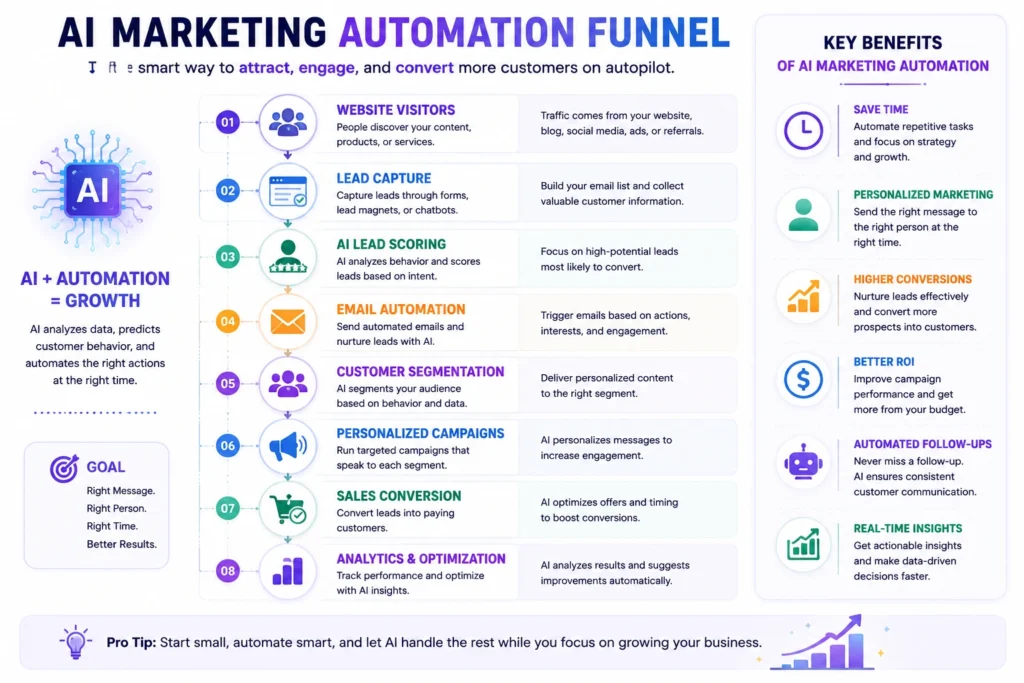
- AI agents in marketing: Autonomous agents that can plan and execute multi-step campaigns with minimal human input.
- Hyper-personalization: Content and offers tailored to individual behavior in real time.
- AI customer support: Chatbots handling more complex conversations with less handoff to humans.
- Predictive analytics: Tools forecasting which leads are most likely to convert.
- Automated content creation: AI generating first drafts of blogs, emails, and ads at scale.
- Voice and conversational marketing: Growing use of voice search optimization and conversational AI interfaces.
Frequently Asked Questions (FAQ)
What is the best AI marketing automation tool in 2026? There isn’t a single “best” tool for everyone — HubSpot is strong for all-in-one needs, Jasper for content quality, and ActiveCampaign for advanced automation. The right choice depends on your budget and goals.
Are AI marketing automation tools free? Some are, at least partially. Tools like ChatGPT, Canva, Buffer, Mailchimp, and Brevo offer free plans, but most cap features, contacts, or usage limits.
Can AI replace digital marketers? Not entirely. AI can handle repetitive tasks like drafting content and scheduling, but strategy, brand judgment, and creative direction still benefit from human oversight.
Which AI marketing tool is best for small businesses? Mailchimp and Brevo are popular starting points for small businesses due to accessible pricing and beginner-friendly interfaces.
How can beginners use AI marketing automation? Start with one or two free tools — like ChatGPT for content and Buffer for scheduling — before investing in paid platforms as your needs grow.
Conclusion
Choosing the best AI marketing automation tools in 2026 comes down to understanding your goals, budget, and how much automation you actually need. Free tools like ChatGPT, Canva, Buffer, Mailchimp, and Brevo are excellent starting points for beginners and small businesses testing the waters. Paid platforms like HubSpot, Jasper AI, and ActiveCampaign offer deeper automation, personalization, and reporting for businesses ready to scale.
There’s no universal “best” AI marketing automation tool — the right pick depends on whether you’re a blogger, small business owner, e-commerce brand, or agency. Start small, test what works, and expand your toolkit as your marketing needs grow. For more guidance on building your AI-powered marketing stack, explore the AI Tools category on Everytechhub.
About the Author
Hi, We are the founders of EveryTechHub. We share beginner-friendly guides on AI tools, blogging, and technology based on hands-on testing and real experience. Read more about us.