
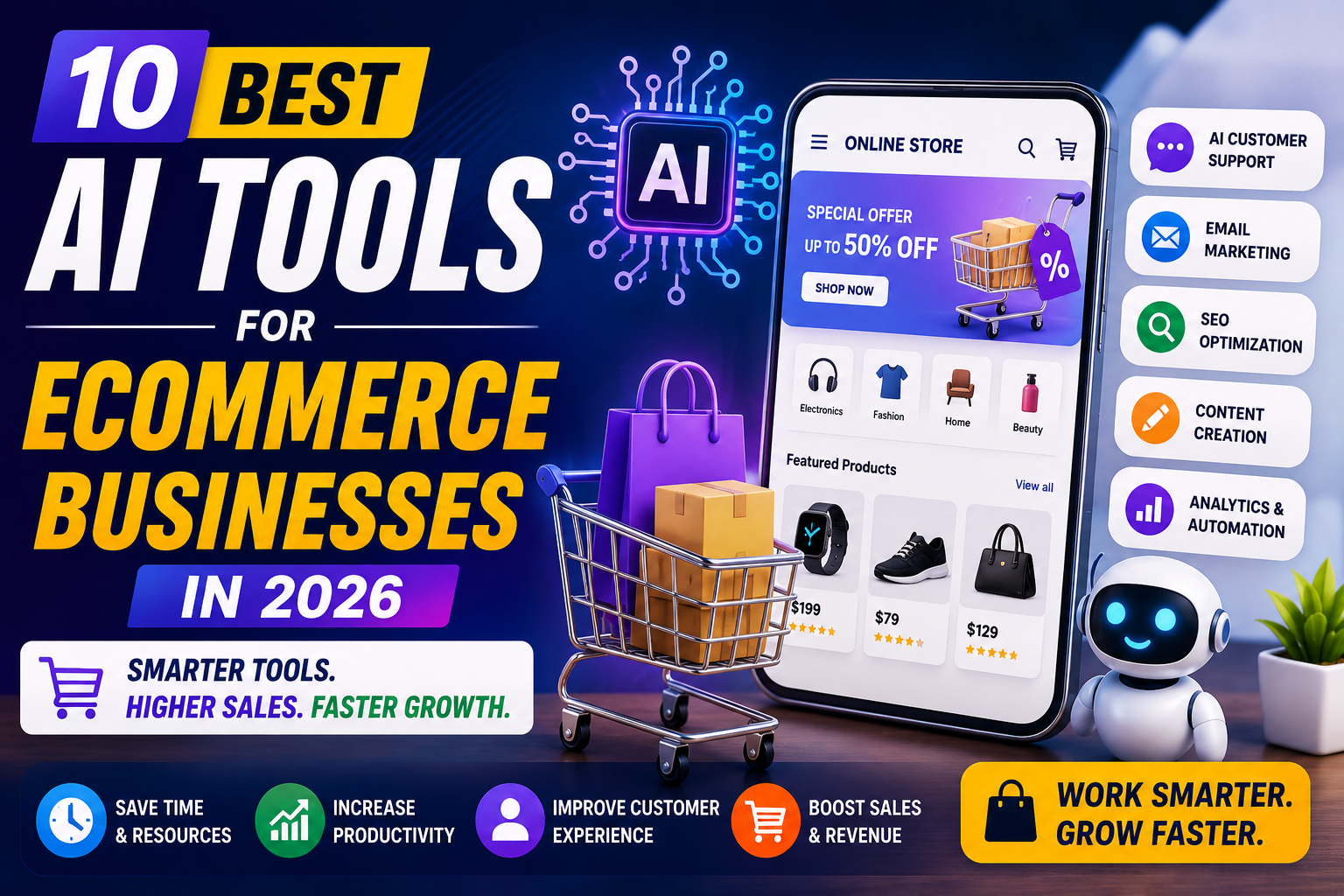
Best AI tools for ecommerce businesses are helping online store owners save time, improve customer experiences, and automate daily operations in 2026. Whether you run a Shopify store, Amazon business, Etsy shop, or WooCommerce website, AI-powered tools can simplify marketing, customer support, SEO, content creation, and workflow management. As competition in ecommerce continues to grow, choosing the right AI solutions can help businesses operate more efficiently while focusing on long-term growth.
This is where artificial intelligence is making a major impact.
The best AI tools for ecommerce businesses can help automate repetitive tasks, improve customer support, create marketing content, optimize product listings, and save valuable time.
The good news is that AI is no longer reserved for large corporations with massive budgets. Today, small businesses and independent store owners can access powerful AI tools at affordable prices.
In this guide, you’ll discover:
- The best AI tools for ecommerce businesses in 2026
- How AI helps online stores grow
- Tools for marketing, content, SEO, and customer support
- Practical ways to improve efficiency
- AI solutions suitable for beginners and growing businesses
If you’re looking for realistic ways to work smarter and improve your ecommerce workflow, this guide is for you.
👉 You may also enjoy our guide on Best AI Tools for Small Business Owners in 2026.
Why AI Is Becoming Essential for Ecommerce Businesses
Online stores face multiple challenges every day:
- Product listing creation
- Customer support inquiries
- Inventory management
- Marketing campaigns
- Social media content
- Email marketing
- SEO optimization
Managing all these tasks manually can quickly become overwhelming.
AI tools help ecommerce businesses by:
- Reducing repetitive work
- Improving productivity
- Supporting data-driven decisions
- Enhancing customer experiences
- Helping teams operate more efficiently
Rather than replacing people, AI often serves as a productivity assistant that helps business owners focus on growth and strategy.
How the Best AI Tools for Ecommerce Businesses Improve Productivity
The best AI tools for ecommerce businesses help streamline operations in several key areas:
Content Creation
Creating product descriptions, blog posts, and marketing copy.
Customer Support
Handling common customer questions faster.
Marketing Automation
Improving email campaigns and social media management.
SEO Optimization
Helping products and content rank in search engines.
Analytics
Providing insights for smarter business decisions.
Businesses that use AI strategically often gain valuable time that can be redirected toward growth initiatives.
1. ChatGPT
One of the most versatile AI tools available today is ChatGPT.
How Ecommerce Businesses Use ChatGPT
Store owners use ChatGPT to help with:
- Product descriptions
- FAQ content
- Email marketing ideas
- Customer communication drafts
- Blog content planning
- Marketing campaigns
Benefits
- Easy to use
- Beginner friendly
- Time saving
- Flexible for many tasks
👉 Official Website: ChatGPT
👉 You may also enjoy our guide on Best AI Tools for Content Creators in 2026.
2. Shopify Magic
Shopify has introduced several AI-powered features under the Shopify Magic ecosystem.
What Shopify Magic Can Do
- Generate product descriptions
- Assist with store management
- Improve customer communication
- Support content creation
Why It Matters
For Shopify store owners, built-in AI tools can reduce content creation time significantly.
👉 Official Website: Shopify
3. Jasper AI
Jasper AI remains a popular choice for ecommerce marketing.
Best Uses
- Product descriptions
- Ad copy
- Email marketing
- Landing pages
- Social media content
Why Businesses Use Jasper
Jasper helps maintain consistent messaging while speeding up content production.
👉 Official Website: Jasper AI
4. Canva
Visual content plays a major role in ecommerce success.
Canva allows businesses to create:
- Product graphics
- Social media posts
- Promotional banners
- Advertisements
- Marketing materials
Why Canva Is One of the Best AI Tools for Ecommerce Businesses
Its AI-powered design features make professional-looking visuals accessible even for beginners.
👉 Official Website: Canva
5. Klaviyo
Email marketing remains one of the highest-converting channels for ecommerce businesses.
Klaviyo helps with:
- Automated email campaigns
- Customer segmentation
- Personalized marketing
- Customer retention
Why Ecommerce Stores Use Klaviyo
It allows businesses to create more relevant customer experiences.
👉 Official Website: Klaviyo
👉 You may also enjoy our article on Best Email Marketing Tools for Beginners.
6. HubSpot AI
HubSpot combines customer relationship management with AI-powered features.
Key Benefits
- Lead management
- Marketing automation
- Customer communication
- Sales support
Why It Helps Ecommerce Businesses
HubSpot centralizes multiple business functions into a single platform.
👉 Official Website: HubSpot
7. Grammarly
Strong communication builds trust with customers.
Grammarly helps improve:
- Product descriptions
- Customer emails
- Marketing content
- Website copy
Why Ecommerce Businesses Use Grammarly
Clear and professional communication can improve customer confidence.
👉 Official Website: Grammarly
8. Surfer SEO
SEO remains one of the most effective long-term traffic strategies.
Surfer SEO helps businesses optimize:
- Product pages
- Blog content
- Category pages
- Ecommerce articles
Why It Matters
Better SEO can help attract organic traffic from search engines.
👉 Official Website: Surfer SEO
👉 You may also enjoy our guide on How to Increase Blog Traffic Organically.
9. Zendesk AI
Customer support is a critical part of ecommerce success.
Zendesk provides AI-assisted support features such as:
- Ticket management
- Chat support
- Customer service workflows
Benefits
- Faster responses
- Improved customer experiences
- Better support efficiency
👉 Official Website: Zendesk
10. Notion AI
Organization matters as businesses grow.
Notion AI helps manage:
- Product launches
- Marketing plans
- Team collaboration
- Content calendars
Why It Works
It combines productivity and organization into a single workspace.
👉 Official Website: Notion
Comparison Table: Best AI Tools for Ecommerce Businesses
| Tool | Best For | Beginner Friendly | Free Plan |
| ChatGPT | Content & productivity | Yes | Yes |
| Shopify Magic | Ecommerce operations | Yes | Included with Shopify |
| Jasper AI | Marketing content | Medium | Limited |
| Canva | Graphic design | Yes | Yes |
| Klaviyo | Email marketing | Medium | Yes |
| HubSpot | CRM & automation | Medium | Yes |
| Grammarly | Writing assistance | Yes | Yes |
| Surfer SEO | SEO optimization | Medium | No |
| Zendesk | Customer support | Medium | Trial |
| Notion AI | Organization | Yes | Limited |
How the Best AI Tools for Ecommerce Businesses Support Marketing
Marketing often consumes a large portion of an ecommerce business owner’s time.
AI tools can help with:
- Content creation
- Social media planning
- Email campaigns
- Ad copy generation
- Customer segmentation
The goal isn’t to eliminate human creativity but to reduce repetitive tasks.
👉 You may also enjoy our guide on Best AI Tools for Social Media Marketing in 2026.
AI and Product Description Creation
Writing hundreds of product descriptions manually can take considerable time.
AI tools can help create:
- Product summaries
- Feature lists
- Marketing copy
- SEO-friendly descriptions
However, businesses should always review and personalize content before publishing.
How AI Improves Customer Support
Modern shoppers expect quick responses.
AI-powered support tools can help:
- Answer common questions
- Route support tickets
- Improve response times
- Provide customer assistance outside business hours
This creates a better customer experience while reducing workload.
Best AI Tools for Ecommerce Businesses and SEO
Search engine traffic remains valuable because it can provide long-term visibility.
AI SEO tools help businesses:
- Research keywords
- Improve content structure
- Optimize product pages
- Analyze performance
Common Mistakes Ecommerce Businesses Make With AI
Relying Entirely on Automation
AI should support your workflow, not replace quality control.
Ignoring Brand Voice
Customers appreciate authentic communication.
Maintain a consistent brand identity.
Using Too Many Tools
More tools do not always mean better results.
Start with a few tools that solve specific problems.
Skipping Human Review
AI-generated content should always be reviewed before publication.
How to Choose the Best AI Tools for Ecommerce Businesses
Start With Your Biggest Challenge
Ask yourself:
- Do you struggle with content creation?
- Marketing?
- Customer support?
- SEO?
Choose tools that directly address those challenges.
Test Free Plans
Many AI platforms offer free plans or trials.
Experiment before committing to paid subscriptions.
Focus on Ease of Use
Complicated software can slow down implementation.
Choose tools that fit your team’s skill level.
Future of AI in Ecommerce
AI technology continues evolving rapidly.
In the coming years, ecommerce businesses may see more advanced AI applications in:
- Product recommendations
- Customer personalization
- Inventory forecasting
- Marketing automation
- Customer support
At the same time, businesses that combine technology with excellent customer experiences will likely remain the most successful.
Frequently Asked Questions
What are the best AI tools for ecommerce businesses?
Popular options include ChatGPT, Shopify Magic, Canva, Klaviyo, HubSpot, Grammarly, Surfer SEO, Zendesk, and Notion AI.
Can small ecommerce stores use AI tools?
Yes. Many AI tools offer affordable plans suitable for small businesses and independent store owners.
Are AI tools expensive?
Some tools provide free plans, while others offer premium features through paid subscriptions.
Can AI improve ecommerce marketing?
AI can assist with content creation, email marketing, SEO, analytics, and campaign management.
Should ecommerce businesses fully automate operations?
No. AI works best when combined with human oversight, customer understanding, and strategic decision-making.
Final Thoughts
The best AI tools for ecommerce businesses in 2026 help online store owners save time, improve productivity, and operate more efficiently.
Whether you’re running:
- A Shopify store
- An Amazon business
- An Etsy shop
- A WooCommerce website
- A growing ecommerce brand
AI tools can support important areas such as marketing, customer support, SEO, and content creation.
The key is not adopting every new tool that appears. Instead, focus on selecting practical solutions that solve real business challenges.
Businesses that combine smart AI adoption with strong customer service, quality products, and effective marketing will be better positioned for long-term growth.
Final Tip
Start with one or two AI tools that address your biggest operational challenges. Once you become comfortable using them, gradually expand your AI toolkit based on your business needs and growth goals.
About the Author
Hi, We are the founders of EveryTechHub. We share beginner-friendly guides on AI tools, blogging, and technology based on hands-on testing and real experience. Read more about us.